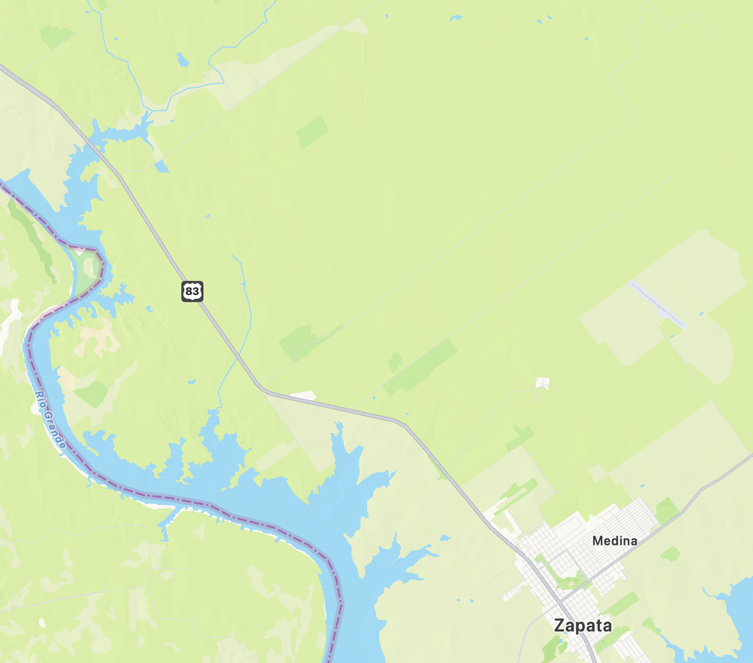
Zapata AFS Texas
South Texas Assignment and Family Sacrifices
After leaving New York, I was assigned to a small radar station in Zapata, Texas, located deep in the southern part of the state, right on the border with Mexico. The base itself was remote and isolated, consisting mainly of radar operations, a few support buildings, and a small cluster of officers’ housing. About five miles away sat the town of Zapata. It almost felt like being back in Mexico, the people were nearly all Mexican American or of Mexican descent. In 1959, the town of Zapata had not yet begun to develop economically. When Falcon Reservoir opened for fishing, the community finally started to boom. Falcon Reservoir offered some of the best bass fishing I had ever seen, and it soon became a major draw for sportsmen across Texas and beyond.
At the time, however, Zapata was still a struggling border town. It lacked a hospital or proper accommodations for families, and most of the available housing was old and in poor condition. Life at the radar station was routine but critical. I was part of a crew responsible for scanning the skies for any aircraft intrusions or irregularities, working rotating shifts to maintain twenty-four-hour coverage. I made a few close friends among the men stationed there, and we looked out for each other like brothers. Even so, the isolation was hard, especially being separated from Madeline and missing the birth of our first child.
There wasn’t much to do in Zapata. In our spare time, we fished, played softball in the evenings when the heat allowed, and gathered around the TV. Occasionally, a group of us would drive to Nuevo Laredo, Mexico, to pick up some “spirits” and souvenirs. Still, most days were quiet, marked by routine and a deep longing for family.
In August 1959, our daughter Julie Annette was born. It was one of the happiest yet most painful days of my life. Because of my duties at the station, I couldn’t be there for her birth. I remember sitting on my bunk, holding the telegram in my hand, wishing instead that I could hold my newborn baby girl.
I carried a small photo of Julie with me everywhere. Her tiny face reminded me why I was serving, to secure a better future for her and Madeline. Letters and the occasional phone call helped bridge the distance, but it wasn’t the same. Missing those first months of her life was one of the hardest sacrifices I endured, and it has stayed with me ever since.
By November 1959, Madeline began considering a move to Texas. She asked me to look for a place for us to live. I warned her that Zapata was no place for a young mother and child. I suggested Laredo, Texas, instead. Laredo had a large Air Force base with a modern, well-equipped hospital. The downside was that I had no car, and Laredo was sixty miles away. I could only visit her on my three days off, once every twelve days.
Madeline didn’t like that plan, so I started searching for housing closer to the station. Eventually, I found an old rental house. It wasn’t what I would call a good home, but it was the best I could find at the time.
In December, Madeline and Julie flew into Laredo, where a friend and I picked them up and drove them back to Zapata. When we arrived at the rental house, Madeline wasn’t happy, but she said she would tough it out so we could be together as a family.
That very first night, she was introduced to the largest cockroaches and insects she had ever seen. I promised her I would spray on my next day off and maybe we could keep them under control. Deep down, I knew it was a battle we were unlikely to win, but I said it to reassure her.
On the second night, Julie became severely ill. A buddy loaned me his car so I could rush her to the doctor at Laredo AFB. After a full exam, the doctor asked how long the baby had been sick. Madeline explained that her symptoms had started the very day we arrived in Zapata. The doctor didn’t hesitate, he told Madeline, “You take this baby back to California.”
The very next day, Madeline and Julie boarded a flight home. And wouldn’t you know it, as soon as they were airborne, Julie’s fever broke. It was as if fate itself had spoken: Zapata was not meant for them. From then on, I would have to tough it out alone for the rest of my tour.
In March 1960, we were informed that the Zapata radar site would be closing later that year, with operations ending in August. This meant our tours would be shortened. By June 1960, I received orders to report to HQ 33rd Air Division in Kansas City, Missouri. I left Zapata and traveled to California to reunite with Madeline and Julie. After buying a car, the three of us drove to Richards-Gebaur AFB, where I would begin my new assignment at headquarters.