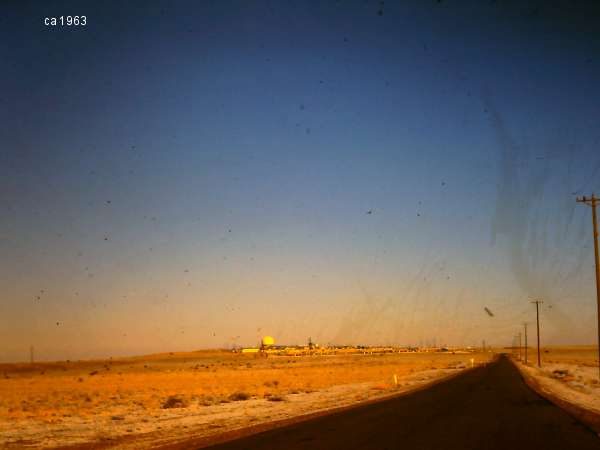
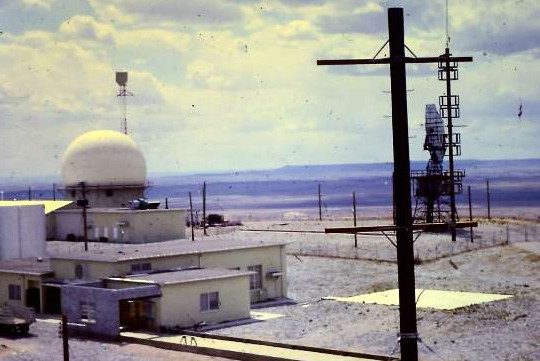
West Mesa AFS New Mexico
In August of 1962, our family was once again on the move. This time, we were headed to the 687th AC&W Squadron at West Mesa Air Force Station in New Mexico. The radar site was located about 15 miles outside the city limits of Albuquerque. We were fortunate to be assigned family housing on Sandia Laboratory Military Base, which gave us access to the military hospital, base exchange, and commissary. The commute to my duty station wasn’t long and felt manageable compared to some of my earlier assignments.
The Albuquerque area offered plenty of opportunities for family life and recreation. We enjoyed movie theaters, weekend drives into the Sandia Mountain Range for skiing, and camping and fishing trips. The scenery was breathtaking, and overall this was one of the more enjoyable assignments I experienced in my career.
At this point in our lives, Julie was three years old and Yvonne was just one. They were too young for school, but they kept Madeline busy at home while I was at work. Living on Sandia Base meant being surrounded by other young families who were going through the same challenges of raising small children while balancing military life. Madeline quickly adjusted, finding comfort in the friendships she made with other mothers. She often shared stories and advice with them, and for her it was a relief to have medical facilities, shopping, and a sense of community nearby after the difficulties of my more remote assignments.
The operations at West Mesa were very different from those at Cape Lisburne (LIZ-1). Instead of a skeleton crew in isolation, our radar team here consisted of 14 personnel: one crew chief, one assistant crew chief, four intercept technicians, plotting staff, tracking staff, and a weather plotter. Everyone trained to become fully qualified intercept technicians, and we rotated through different duties so we could step into any role required in the radar room.
Unlike the relative quiet of the Arctic skies, the airspace over New Mexico was busy around the clock. We monitored both civilian and military aircraft, providing flight following for all military flights and assisting civilian flights when requested. Coordination with the FAA was routine, as we notified them whenever military traffic crossed into civilian-controlled airspace. The pace was steady and demanding, but the teamwork and variety made it a rewarding assignment.
Although my work schedule kept me busy, I tried to make the most of family time. On days off, we explored Old Town Albuquerque, with its historic plaza, adobe buildings, and small shops that reminded me of my family’s Mexican heritage. The blend of cultures, Anglo, Native American, and Hispanic, was something I felt very connected to, and it gave us a sense of belonging in this unique place.
This assignment marked an important turning point in my career. After enduring the hardships of isolation and separation in earlier postings, New Mexico provided stability for my family while allowing me to continue advancing professionally. It was the balance we had long been hoping for, and I was grateful for it.
Everything was normal, and we went about our duties as usual. On our days off, we spent time with friends and family, until October 16, 1962, when everything changed. At approximately 2:00 AM, I was awakened by a recall telephone call. The caller simply said: “Alert! Alert! This is no drill recall. Report as soon as possible.” I drove around picking up other airmen at their homes, and together we headed to West Mesa.
On arrival, we were shocked to see security police in full battle gear, heavily armed. Even though they knew us personally, we were still required to show identification before being allowed entry. Immediately, we knew something serious was happening. Once inside, we reported to the briefing room and were informed that we were now at DEFCON 3, only two steps away from all-out war, I think we did go to DEFCON 2 later on. It was the beginning of the Cuban Missile Crisis.
Our briefing included air defense duties, weapons deployment, and strict orders of no communication with the outside world. A liaison officer was assigned to speak with our wives and provide support in case of emergencies. Mobile radar units were deployed to Florida to control and monitor strike aircraft, and some of our personnel were issued weapons and sent to man those sites.
Because I held a Top Secret clearance and was fluent in Spanish, able to both read and write it, I was selected for a special activity unit at Patrick AFB, Florida. I was gone from October 16 to November 29, 1962. Looking back, I believe this was one of the hardest times in Madeline’s life. She had no idea where I was, and she had to face the possibility of war completely on her own.
After the Crisis
After the Cuban Crisis, operations at the site gradually returned to normal. Myself, one officer, and about six airmen were assigned to work at the FAA Albuquerque Center to help FAA personnel become familiar with our radar operations. At the time, the FAA was installing radar equipment nationwide, but some of their people lacked the experience the Air Force had in traffic control using radar. I remained at the FAA Center until my next assignment, and needless to say, this was excellent duty.
Not long after, the Air Force again requested that radar sites consider reductions in personnel manning due to the implementation of the SAGE system. Airmen were given the option to retrain as Security Police or Cooks. Since most of us were already highly qualified in both Automatic and Manual radar systems, we held out for better opportunities. Finally, a message arrived allowing certain qualified personnel to retrain as computer operators. Those selected would attend a 12-week school in Texas, and upon completion, be reassigned to new locations.
I applied and was fortunate to be selected in July 1963. Once again, Madeline and the children left for California while I headed to Sheppard AFB, Texas. I completed the training in October, and by November I was at my new duty station, the 544th Air Reconnaissance Technical Wing at SAC Headquarters, Omaha, Nebraska.