Randolph AFB San Antonio Texas
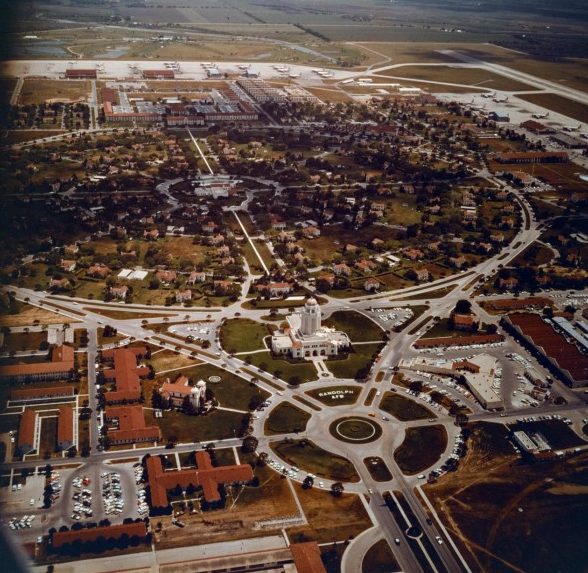
Photograph of an aerial view of the Randolph Air Force Base in Bexar County, Texas. Two streets run toward a roundabout at the entrance of the base. The words "Randolph AFB" are visible in the roundabout's top center grassy median, in line with the base's large, domed administrative building. Beyond this building, houses are arranged along a radial road pattern. Many larger buildings surround this circular neighborhood. Rows of airplanes sit on large concrete areas on the far right and at the back of the base. Grassy pasture land and some small bodies of water are visible in the distance.
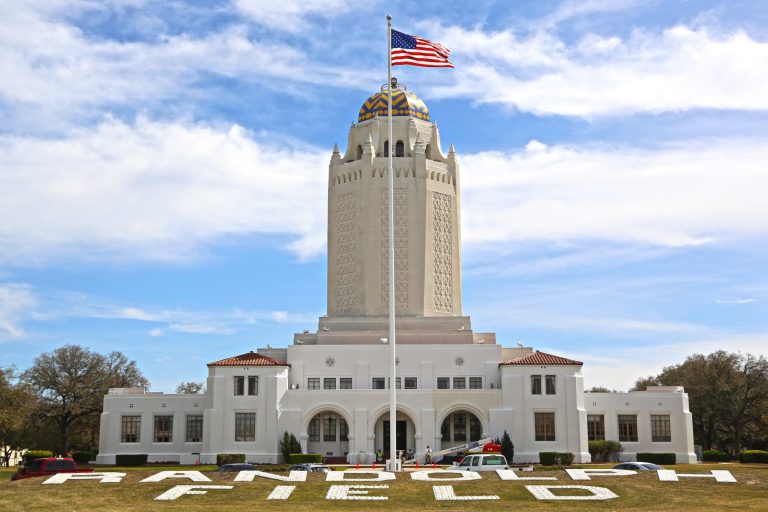
San Antonio-Randolph’s most iconic structure, commonly referred to as the “Taj Mahal,” was finished in 1931 at what was then-Randolph Field for $252,000 , equating to $3.8 million today. (U.S. Air Force photo by Joshua Rodriguez)
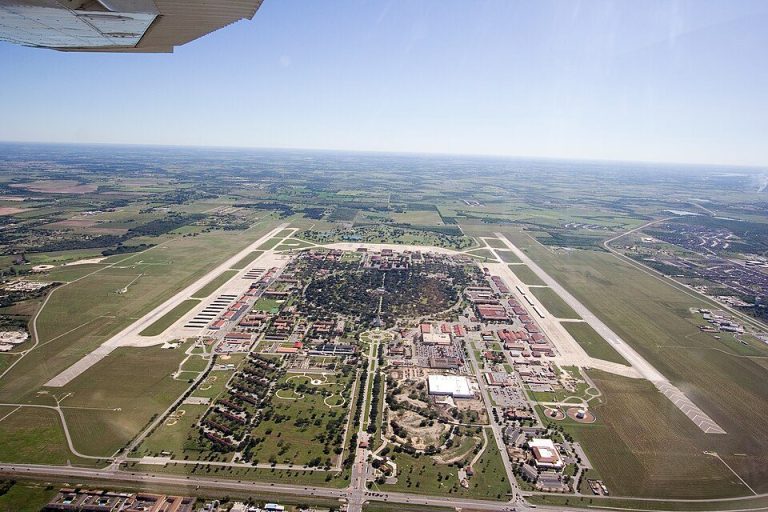
Aerial photo of Randolph Air Force Base from 2500 feet.
San Antonio, Texas
In December of 1966, we packed up our lives in Omaha and headed west. Before reporting to my new assignment in San Antonio, Texas, we made an important stop in California to spend Christmas with Madeline’s family. The holiday gathering was filled with warmth, laughter, and the comfort of being surrounded by loved ones. After years of moving from base to base, these family visits had become especially meaningful to both of us.
When the celebrations came to an end, it was time once again to face change. I reported for duty in San Antonio, a city rich in history and tradition. The Alamo, the River Walk, and the Spanish missions gave the city a unique character, blending deep Mexican roots with proud Texas heritage.
My Air Force assignment in San Antonio brought new responsibilities and a shift in routine compared to the Intelligence Data System work I had done before. This was a completely new role: I was now training as a systems analyst, working at a more advanced level of computer operations and systems management.
For our family, the move was both exciting and challenging. By this time, the children were getting older and their needs more demanding. Finding good housing and schools, and establishing a stable family routine, became just as important as my new job. Not long after arriving in San Antonio, we faced a serious challenge when our youngest child, Lisa, contracted pneumonia and had to be hospitalized. Thankfully, we were fortunate to have some of the best military hospitals in the city. Once again, Madeline showed her strength, managing the household, helping the children adjust, and keeping us grounded through the constant changes that military life required.
I learned that base housing had a long waiting list, with no guarantee of when a unit would open up. That meant I had to go house hunting near Randolph AFB. A sergeant in the orderly room suggested it might actually be cheaper to buy a home than to rent. He directed me to a new housing development not far from the base, and off we went in search of our first home. We found a brand-new three-bedroom house in a very nice neighborhood with community swimming pools. In 1967, I became a homeowner for the first time. My mortgage was $11,000, and the monthly payment was $99.
We soon settled into our new home and enrolled Julie and Yvonne in school. Madeline focused on caring for Mark and Lisa, keeping the house in order while I began my new duties.
My boss was a colonel, and our team consisted of two technical sergeants and four staff sergeants. I was the senior enlisted member, reporting directly to the colonel. As systems analysts, our responsibilities included analyzing and designing efficient software solutions to meet mission needs. We evaluated information systems, worked closely with end-users, software vendors, and programmers, and ensured that projects met their objectives. Our duties also involved assessing system performance, recommending new technologies, developing test procedures, and managing the implementation and maintenance of new or improved systems.
San Antonio quickly grew on us. The warm climate was a welcome change from the harsh winters of Omaha. The food, the music, and the friendly people made it easy to feel at home. It was a place where our family could truly thrive, even as the demands of my military career continued to shape our lives.
At the time, San Antonio was undergoing a major transformation. The city was preparing for HemisFair ’68, a world’s fair that sparked a wave of urban renewal. Madeline and the children adapted quickly, making friends with our neighbors and their children. It always amazed me how easily military kids adjusted to change and made new friends wherever they went.
We began exploring the city’s many attractions. Of course, we visited Mission San Antonio de Valero, better known as The Alamo. Other missions were not as popular yet, but that changed after HemisFair opened. Madeline loved the River Walk along the San Antonio River. It was a wonderful place to visit in the evenings, to sit, listen to mariachi music, and enjoy dinner at one of the small restaurants.
In 1967, the River Walk had only a few restaurants and shops, but the area expanded rapidly in preparation for HemisFair. Every chance we had, we visited the River Walk, and after the fair opened, we went as often as possible.
I also enjoyed my own outdoor activities. Texas offered excellent hunting and fishing. I went deer hunting at Camp Bullis and fished in many lakes and reservoirs in the area. Hunting at Camp Bullis could be nerve-wracking, it was used by the Army to train Combat Medics, and in the early morning darkness it was easy to set off a training booby trap that could scare the life out of you! It was always wise to carry a strong flashlight and move carefully.
One memorable day, when Lisa was two years old, she and Mark went exploring in the field behind our house. The field was covered in tall weeds, some taller than Lisa, and it was wet and muddy. Lisa got stuck, lost her shoe, and became separated from Mark. In a panic, Mark searched for her but couldn’t see through the weeds. I heard her crying and rushed out to help. When I arrived, Mark had just found her, and both were crying with relief. Once they were safe, it was time for their milk break and Lisa’s favorite TV show, “Buck Owens and the Buckaroos.” She loved that show, every evening she would bring out her little chair, sit with a glass of milk, and watch until it ended, ready for bed afterward.
We spent three wonderful years in San Antonio. During that time, I reconnected with my cousin Gilbert Ayala, who was stationed at Kelly AFB. We also spent time with my mom’s aunt Josephine Sepulveda and her family. By then, my great-uncle Jesse Sepulveda had passed away, and I regretted not seeing him one more time, he and Aunt Josephine had always been very special to my mom. My mother came to visit us and spent six days with her aunt; together, they even took a short trip to Josephine’s hotel in Monterrey, Mexico.
My job schedule was excellent, Monday through Friday, 8 to 5, which allowed me to spend more quality time with my family. Madeline, as always, had her hands full caring for Mark and Lisa while keeping the household running smoothly. To supplement our income, I decided to take a part-time job and was fortunate to find one at Gross National Bank in downtown San Antonio. There, I helped run their computer system, processing balance ledgers and other financial documents alongside another Air Force airman. It was an excellent position, located right by the River Walk with a clear view of the HemisFair construction site.
The biggest benefit of that part-time job was the experience I gained in banking operations and federal financial regulations, knowledge that would later prove invaluable in my civilian career.
In June of 1970, I was informed that the Air Force could no longer defer my overseas assignment. I had completed my travel restriction period, and it was now time for a new tour of duty. I received orders for a one-year assignment in Vietnam, where I would serve with the 31st Combat Support Group (TAC), stationed at Tuy Hoa, Republic of Vietnam, reporting in August 1970.
Once again, Madeline and I prepared ourselves for another year-long separation, a challenge that had become all too familiar in our military life. She decided to move to California with the children to be closer to her parents while I fulfilled my Vietnam tour. Having her family’s support nearby brought her comfort and stability during my absence, and it gave the children the love and attention they needed while their father was away serving overseas.