Offutt AFB Nebraska
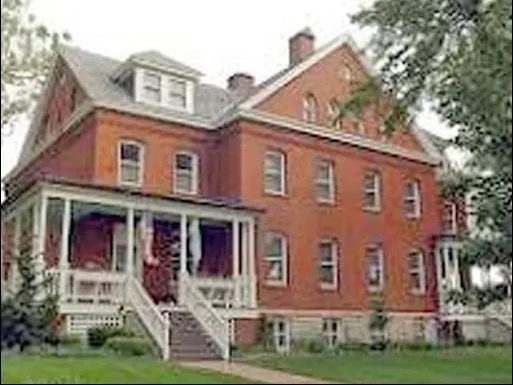
In 1947, the National Security Act established the Department of the Air Force as a separate service and on January 13, 1948, Fort Crook was transferred to the new service and christened Offutt Air Force Base. Strategic Air Command moved its headquarters here in 1948 from Andrews Air Force Base, Md. SAC was responsible for command and control of the strategic bomber and intercontinental ballistic missile components for the U.S. military from 1946 to 1992. That same year U.S. Strategic Command was established, unifying all strategic forces under one unified command.
Near Omaha, NE, Offutt AFB was the home of Headquarters Strategic Air Command (SAC) until 1992 when SAC was disestablished in the post-Cold War Air Force reorganization.
One of the older bases in the Air Force, Offutt was commissioned in 1894 as Fort Crook. Named for a Civil War officer, Major General James Crook, the Fort and the General were central to the Indian conflicts throughout the Great Plains.
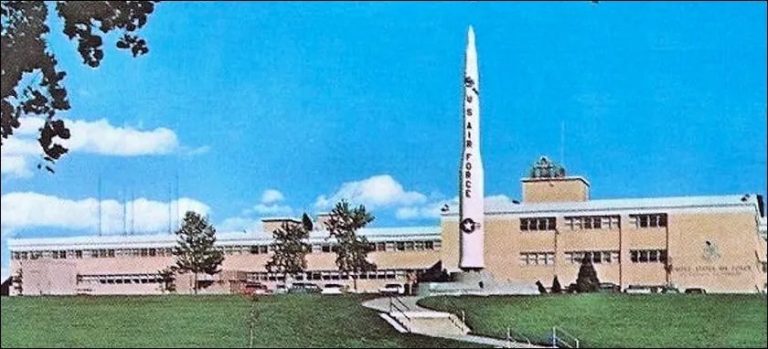
SAC HQ. Offutt AFB
Fort Crook was still evident when I was at Offutt, with the original Parade Ground and several large old brick homes, known during my time as General’s Row for the senior officers who lived there.
Omaha Nebraska
In late October of 1963, I arrived at Offutt Air Force Base in Nebraska and reported to my new duty assignment with the 544th Aerial Reconnaissance Technical Wing. This unit played a crucial role in aerial and technical intelligence gathering for Strategic Air Command (SAC) and the United States Air Force. Offutt was the headquarters of SAC, and the sense of importance and responsibility was felt the moment I stepped on base.
My initial duties were slated to be as a computer operator in the intelligence computer room. However, before I could begin that work, I needed to obtain a special security clearance. While waiting for clearance, I was assigned to a casual squadron within the wing, a holding unit where new arrivals stayed until their paperwork and background checks were complete.
During this waiting period, we were given an unexpected opportunity. All new computer operators were offered the chance to attend IBM 1401 programming school at the IBM Systems offices in Omaha. I quickly requested to attend and was fortunate enough to be selected. The school lasted six weeks, and I found myself fascinated with the emerging field of computer programming. The IBM 1401 was one of the earliest business computers, and learning to program it felt like being part of the future.
At the end of the course, our performance was evaluated by IBM instructors. Based on those results, a select few of us were chosen to continue advanced training on the IBM 7094, a much more powerful system used for scientific and technical calculations. This training included the use of FORTRAN, one of the earliest high-level programming languages. Once again, I made the grade and was selected to continue on the programming career track—something that would shape my future in unexpected ways.
When Madeline, Julie, Yvonne, and I arrived at Offutt, we were informed that base housing would not be available for at least sixty days. With little choice, we found a small place in Bellevue, Nebraska, which we could rent month-to-month. Madeline and the children quickly adjusted, making new friends with the neighbors, while I focused on my classes.
Our courses were conducted by IBM Federal Systems in downtown Omaha, which meant I had to commute every morning from Bellevue into the city. In the fall, the weather was manageable, but as the Nebraska winter set in, the snow and icy roads made commuting a real challenge. Despite the hardships, I pressed on, knowing that the education I was receiving would be invaluable, not only for my Air Force duties, but also for my own professional growth.
The Air Force required us to wear a coat and tie when working or attending class at IBM, so we all wore civilian clothing when assigned to downtown IBM. All programmers assigned to the 544th ARTW who did not yet have the security clearance to work in the basement at SAC headquarters were temporarily assigned to IBM Federal Systems in Omaha. I would spend an entire year working downtown, gaining invaluable on-the-job training in programming and the operating systems I would later use in my career.
During this time, my family and I finally moved into base housing. It was a long building divided into four units, and we were assigned a three-bedroom apartment with plenty of room for the family. However, when we moved in, we quickly realized we were not welcomed by our neighbors. They avoided us at all costs, and this cold-shoulder treatment went on for nearly three months.
I finally broke the ice with one of my neighbors, Bob Forgas. I asked him directly why the families around us avoided talking to me or my wife. Bob admitted that most of them assumed I was a special investigator, since I wore civilian clothes to work and rode in a military vehicle to and from the base every day.
The way I met Bob and his wife Margaret was through my daughter Julie. Julie and Yvonne were playing in the common area of the housing complex when Julie offered Carol, Bob and Margaret’s daughter, a freshly made tortilla from Madeline’s kitchen. Carol gladly accepted it and brought it home to show her mother. Margaret was upset at first that Carol had taken food from a stranger, but when she tasted the tortilla herself, she admitted it was delicious and told Carol to go back and get one more.
From that simple moment, everything changed. Our families became inseparable. To this day, Bob and Margaret’s children call Madeline “Auntie” and me “Uncle,” while our children and theirs still call each other cousins. What began with a homemade tortilla grew into a lifelong friendship that endured far beyond our years in Omaha.
We also became lifelong friends with our other neighbors, Fern and Herman Mullins. We kept in touch for many years until Fern passed away and Herman eventually stopped writing.
In 1963, we hosted a party at our home with some of my co-workers and with Herman, Fern, Bob, and Margaret. It was such a good time that Fern, Margaret, and Madeline each had a child nine months later. I don’t know how much we drank that night, but since no one had to drive home, we all enjoyed ourselves without worry. A good time was truly had by all.
As for my job at the 544th ARTW, I can’t disclose the details of what we processed or accomplished, but I can say that it was a real-time intelligence data processing system. I participated in writing real-time operating systems and programming applications—that is about as far as I can go. Still, my time at the 544th was a remarkable learning experience, and it set me on a serious course for my career. With the experience I gained there, I knew I could handle any job the Air Force assigned me in the Computer Systems career field.
Looking back, I would say that my assignment to Omaha was one of the best we ever had as a family. We made great friends and had access to many entertainment places. The friendships we built there became lifelong bonds. We hosted parties where co-workers and neighbors all joined in, and it often felt as if we were one big clan. I truly miss the good times we shared during those years.
Being stationed in Omaha gave me the opportunity to visit my parents in Scottsbluff, on the western side of Nebraska. To make the trip, I usually had to take a couple of days off around a weekend.
Most importantly, I was able to be present for the births of my children, my son Mark, born on July 14, 1964, and my baby girl Lisa, born on January 11, 1966.
In early September of 1964, my mother called to tell me that my father was in the hospital in Cheyenne, Wyoming, and that he had “requested to see all the children.” I immediately requested leave, and we drove all day to Cheyenne. As soon as I saw him, I knew he was in bad shape. He told me he had pancreatic cancer and that treatment had begun. The doctors explained that his condition was very serious and that they would do everything possible to keep him comfortable. My dad hugged each of my children, told me he loved us, and we said goodbye until I could get more leave to return. We spent a couple of days with Mom and the rest of the family, knowing in our hearts that Dad would not be with us much longer. Then we returned to Omaha and waited for the time we would have to go back to Scottsbluff.
On November 20, 1964, I returned to Scottsbluff for the funeral of my dear father. It was one of the saddest days of my life. Growing up, he had always taught me something important. At the time, I didn’t realize how a self-educated man could be so wise. He taught me to read and write in Spanish, helped me with math, and in his rare spare moments, he wrote poetry.
I will dearly miss him.
It was a wonderful three years and three months in Omaha, full of personal and professional growth. Eventually, I received a new assignment to Headquarters United States Air Force, 1105 MP Group, at Randolph AFB in San Antonio, Texas. We were headed back to Texas, this time for a special assignment in San Antonio.